When you open a Private Placement Memorandum (PPM) for the first time, the waterfall distribution section might look like dense legalese. It’s not. It’s the single most important section in the document because it tells you exactly how investors get paid.
A waterfall distribution is called that for a simple reason: it describes how money flows down through a series of tiers, each one filling up before the next begins. Think of it as a priority system for who gets paid, how much, and in what order.
That priority system is where the real due diligence happens.
How It Works: A Real Example
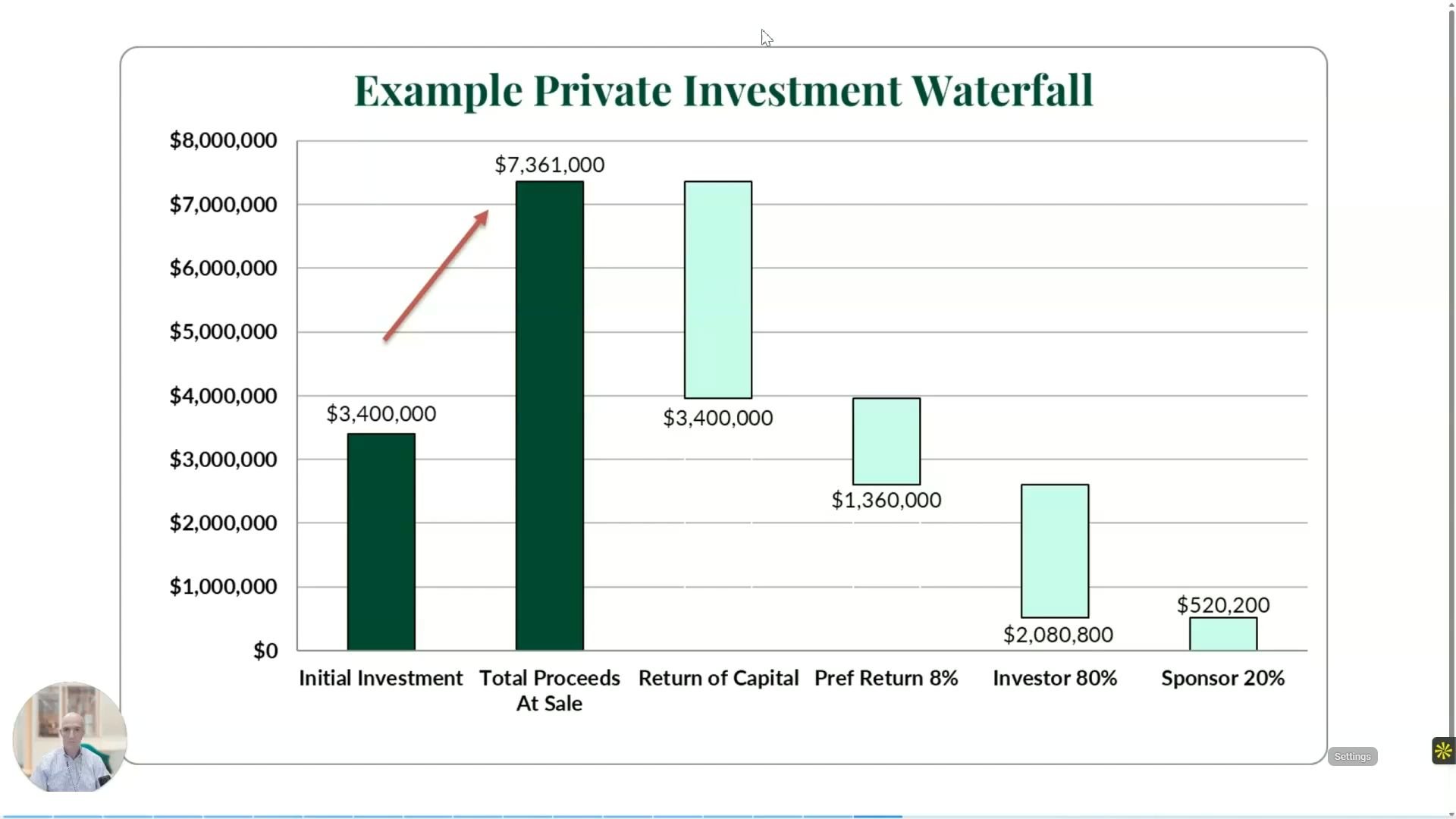
In the video below, CCM CEO Ian Colville walks through an actual waterfall distribution chart step by step, showing how $3.4 million in investor capital flows through each tier to generate $7.3 million in total proceeds.
The setup: Investors contribute $3.4 million in total capital. The sponsor uses that capital to acquire or develop an asset, in this case a real estate project. After a 5-year hold period, the asset is sold for total proceeds of approximately $7.3 million.
Now the waterfall begins. That $7.3 million doesn’t get split evenly or distributed all at once. It flows through three distinct tiers.
Tier 1: Return of Capital ($3.4 million)
Before anyone talks about profits, investors get their original $3.4 million back. Every dollar of contributed capital is returned first. This is the most critical hurdle in any deal. It means the sponsor doesn’t touch a dime of profit until investors have been made whole on their principal.
Tier 2: Preferred Return (~$1.36 million)
Once capital is returned, investors receive their preferred return, in this case an 8% annual non-compounding return on their invested capital. Over the 5-year hold period, that amounts to roughly $1.36 million. Think of this as the minimum performance threshold. Investors earn this before any profit sharing kicks in.
Tier 3: Profit Split, 80/20 (~$2.6 million remaining)
Only after investors have received both their full capital and their preferred return does the remaining profit get split. In this structure, investors receive 80% and the sponsor receives 20%. On the remaining ~$2.6 million, that means roughly $2.08 million goes to investors and approximately $520,000 goes to the sponsor.
That sponsor share has a name you’ll see often: the promote, also called carried interest. It’s the sponsor’s performance fee, and critically, it only exists because the deal performed well enough to clear both prior hurdles.
Why This Matters for Investors
The waterfall structure is an alignment mechanism.
When a sponsor only gets paid after investors receive their capital back and earn a preferred return, they have a direct financial incentive to perform. A deal that returns capital but misses the preferred return means the sponsor earns nothing beyond any management fees. A deal that loses capital means the sponsor definitely earns nothing.
This is the alignment of interests you should be evaluating in every private placement you review.
What to Look For in a PPM
The example above is a fairly standard two-hurdle waterfall. But structures can get significantly more complex. Some things to scrutinize:
• The preferred return rate and whether it compounds. An 8% non-compounding preferred return is meaningfully different from an 8% compounding one over a 5-year period.
• Whether there’s a catch-up provision that allows the sponsor to receive a larger share of profits after the preferred return is met, before reverting to the standard split.
• How many hurdle rates exist. Some deals have multiple tiers with escalating sponsor participation as returns increase.
• Whether the waterfall applies at the deal level or the fund level, which affects how gains and losses across multiple investments interact.If you are a wealth advisor, your job as a fiduciary is to understand exactly how and when your clients get paid. The waterfall section of the PPM is where that answer lives.