It’s been a rough week for stock investors. The S&P 500 has fallen in six of its last seven sessions since hitting an all-time high, slipping into negative territory for the year. The Nasdaq 100 posted its worst three-day rout since last April’s tariff meltdown. The iShares Expanded Tech-Software Sector ETF is down about 17% year-to-date. And after Thursday’s close, Amazon plunged after announcing roughly $200 billion in planned 2026 capital expenditures and missing on earnings, following Alphabet’s forecast of $175 billion to $185 billion in capex that spooked investors earlier in the week.
As Jim Cramer noted on CNBC, this week is a powerful reminder of why diversification matters. But the truth is that most portfolios aren’t as diversified as they appear.
The Problem with “Diversification”
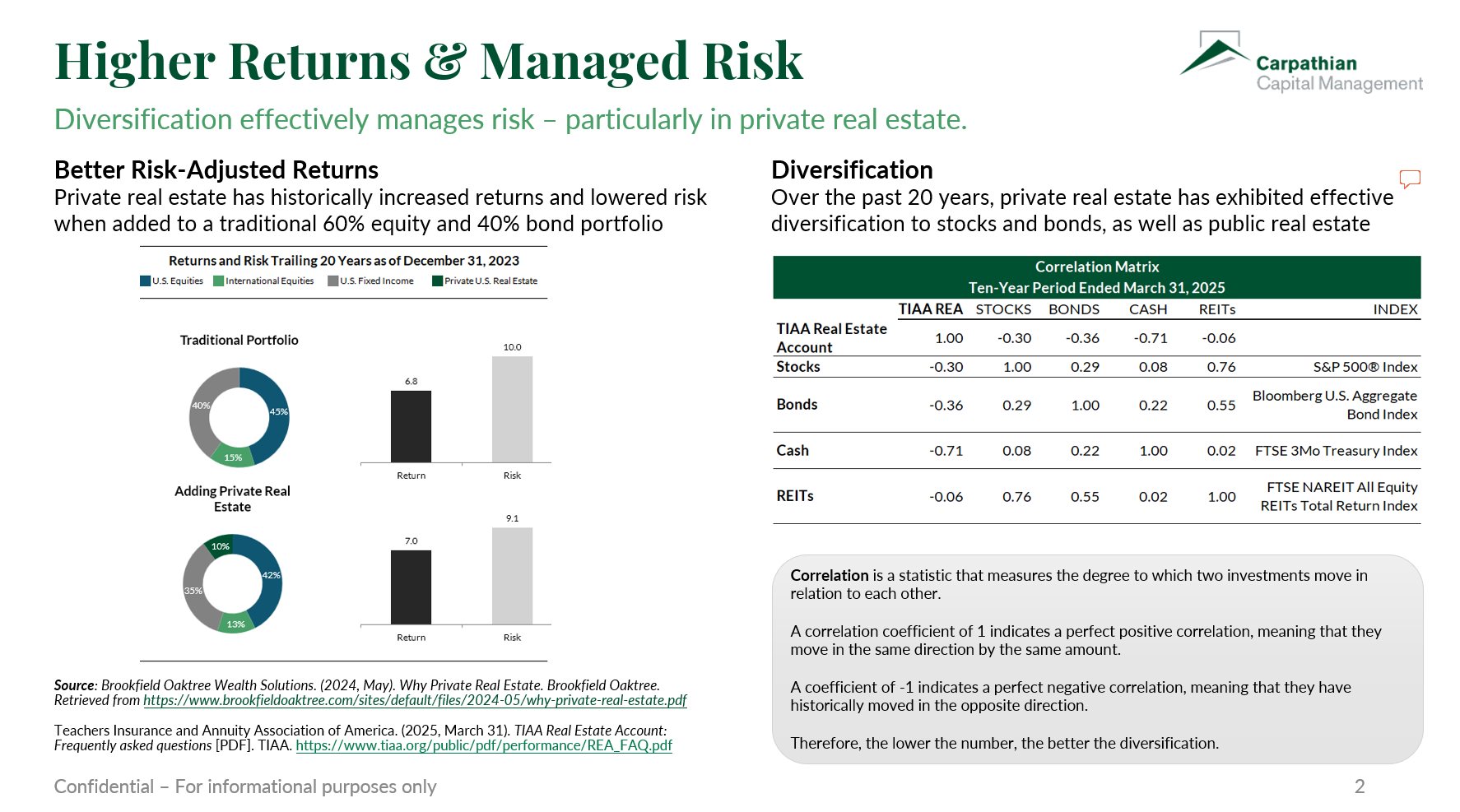
REITs are publicly traded, and their prices move with market sentiment — not just property values. Over the past ten years, REITs showed a 0.76 correlation to the S&P 500. Bonds haven’t helped either; inflation has contributed to a positive correlation between stocks and bonds — undermining the diversification benefit that the traditional 60/40 portfolio is supposed to provide. And with only 19% of S&P 500 stocks outperforming the index over the past year, even broad equity exposure has really been a concentrated bet on a handful of tech names.
Why Private Real Estate Is Different
Private real estate — held directly, not through public markets — is driven by fundamentally different forces: rental income, occupancy, local supply and demand, and the tangible value of land and structures.
The data is compelling. The TIAA Real Estate Account’s ten-year correlation matrix (through September 30, 2025) shows private real estate’s correlation to stocks at -0.28 and to bonds at -0.36. Compare that to REITs at 0.76 to stocks. And research from Brookfield Oaktree Wealth Solutions found that adding private real estate to a traditional 60/40 portfolio increased returns from 6.8% to 7.0% while lowering risk from 10.0 to 9.1 over the trailing 20 years ended December 31, 2023.
More return and less risk. That’s rare.
Why Now
The case is especially strong heading into 2026. Midterm election years have historically produced a 10%+ correction about 70% of the time. Valuations remain elevated at 22.2x forward earnings. And a potential Supreme Court ruling on presidential tariff authority could shift expectations quickly.
At Carpathian Capital Management, we invest in residential real estate development — joint venture equity alongside land developers and homebuilders in the Midwest and Southeast. When Amazon loses billions in market cap over an earnings call, it has zero bearing on home sales in growing suburban markets or the value of entitled residential lots.
True diversification means owning assets driven by fundamentally different economic forces. Private residential real estate belongs in that conversation, and weeks like this one prove why.